
- You are here:
- Home

- About
- Our Community
- Ensuring a Safe Environment

Contact Felipe Sanchez, Director of Administrator | (310) 566-1502 |
About Safeguard the Children
Providing a safe environment for children, youth, and vulnerable adults
Safeguard the Children is a comprehensive program designed to promote a safe environment for children, youth and vulnerable adults and prevent child sexual abuse. The program was initiated in all dioceses in the United States at the direction of the United States Conference of Catholic Bishops (USCCB).
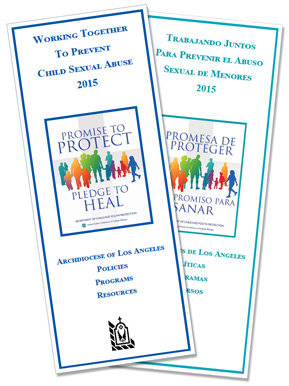 There is a Safeguard the Children (STC) Committee in each parish which helps to implement the objectives of the USCCB “Charter for the Protection of Children and Young People.” The Archdiocese of Los Angeles has produced an informative brochure entitled "Working Together" that provides resources on how to prevent abuse and provides information on reporting child abuse. You can find it along with more information about the policies and activities of the Archdiocese of Los Angeles in “Protecting Our Children" at www.lacatholics.org/departments-ministries/protecting-children/ .
You can also read the monthly bulletin put out by the Archdiocese of Los Angeles at: www.lacatholics.org/did-you-know/
Requirements for Parish Clergy, Staff, and Volunteers at St. Monica
- All volunteers and clergy, along with our staff, regardless of whether they work with or around children in any way, are required to attend a VIRTUS session, “Protecting God’s Children” adult awareness training session.
- Any volunteer who supervises or is perceived to supervise children in any way is required to submit to a background check in the form of fingerprinting by the Archdiocese of Los Angeles. You can sign up for free at LiveScan fingerprinting
- Faith Formation volunteers, students and their parents take part annually in the ”Empowering God's Children” or other approved safe environment education program.
- All parish staff are required to submit to a background check in the form of fingerprinting by the Los Angeles Archdiocese
For a schedule of VIRTUS sessions and fingerprinting at St. Monica, please check latest announcements or the calendar. You can also call the Parish Office at (310) 566-1500 for dates as well.
Child Abuse Prevention Month
-
Child Abuse Prevention Month: April 2024
In honor of National Child Abuse Prevention Month, April 2024, the Archdiocese of Los Angeles invites you to join us in transforming awareness into action by participating in a special nine-day Novena for Protecting and Healing from Abuse.
The Office of Safeguard the Children is dedicated to “protecting all of God’s children” by fully implementing Article 12 of the Charter for the Protection of Children and Young People adopted by the United States Conference of Catholic Bishops in 2002. The office provides ongoing support, education, training and resources to help prevent child sexual abuse and to address children’s safety in our parishes, schools, homes and communities.
To this end, St. Monica Safeguard the Children (STC) Committee continues to assess and implement the objectives of the charter and to protect vulnerable populations in our midst. Our community regularly hosts VIRTUS training and fingerprinting opportunities to ensure that our volunteers, clergy, and staff have been trained on what a safe environment should look like. It is important that everyone is aware of what abuse can look like, and that we report suspected child or elder abuse. We are all responsible for the care and safety of children and vulnerable adults.
The Archdiocese of Los Angeles also continues helping survivors of sexual abuse and their families during National Child Abuse Prevention Month, and on behalf of Archbishop José H. Gomez, we affirm our continued commitment to report allegations of sexual misconduct to law enforcement, support victim-survivors in their healing journey, and protect children and the vulnerable.
As a community, we hold victims and survivors in our hearts and pray for healing throughout our nation. We will light our candle and in a special way pray for protection and healing from abuse. May we all find comfort in the love and support of our community, gathered together to protect the most vulnerable.
"United in Prayer" Novena
Together for the next nine days, let us pray that the vulnerable are protected from abuse, and that survivors of abuse may be accompanied ont heir paths to healing.
Intercessions
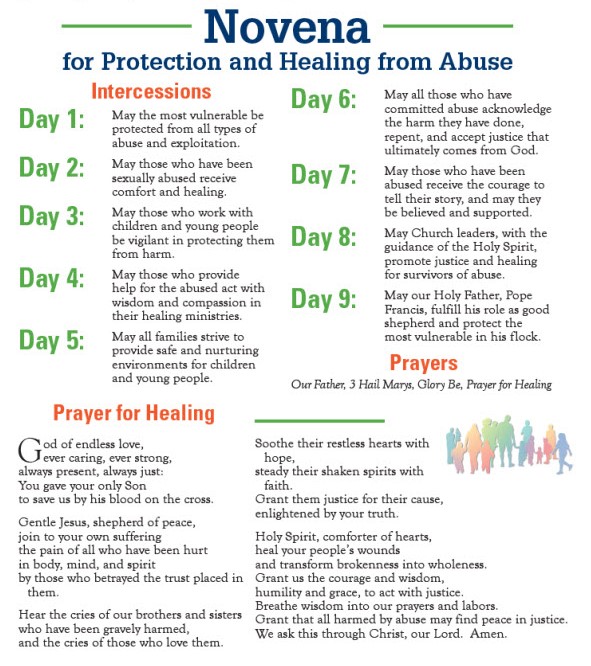
Click Here to View Daily Intercessions!
Prayers
Our Father, 3 Hail Marys, Glory Be, Prayer for Healing
Prayer for Healing
God of endless love,
ever caring, ever strong,
always present, always just:
You gave your only Son
to save us by his blood and cross.
Gently Jesus, shepherd of peace,
join to your own suffering
the pain of all who have been hurt
in body, mind, and spirit
by those who betrayed the trust places in them.
Hear the cries of our brothers and sisters
who have been gravely harmed,
and the cries of those who love them.
Soothe their restless hearts with hope,
steady their shaken spirits with faith.
Grant them justice for their cause,
enlightened by your truth.
Holy Spirit, comforter of hearts,
heal your people's wounds
and transform brokeness into wholeness.
Grant us the courage and wisdom,
humility and grace, to act with justice.
Breathe wisdom into our prayers and labors.
Grant that all hamred by abuse may find peace in justice.
We ask this through Christ, our Lord. Amen.
Did You Know?
-
-
Safeguard the Children: Did You know Created on Monday, 27 November 2023Read more...
Nearly every public campaign about the evils of sex trafficking involve child female victims. A majority of victims are female, but there are many male victims, and they are mostly silent. Societal expectations often lead men to feel that they should be “strong” and “a...
-
Safeguard the Children: Did You know Created on Monday, 27 November 2023Read more...
One of the best ways safe adults can help children who are suffering from abuse is to recognize and listen to their disclosures — even if they are done in stages or in subtle ways. A child may float a “trial balloon” disclosure, meaning he may use a single sentence or ...
-
Safeguard the Children: Did You know Created on Monday, 27 November 2023Read more...
This Christmas, your family will likely be in a crowd or two — at school functions, visiting Santa at the mall, Christmas Eve Mass. According to the National Center for Missing and Exploited Children, over 400,000 children go missing every year in the US. Crowds are a ...
-
Safeguard the Children: Did You know Created on Monday, 27 November 2023Read more...
Safe adults should be on the lookout for signs of physical abuse in children in their care. Some signs include frequent bruises or cuts, frequent and unexplained absences or injuries. Physical abuse can include hitting, kicking, shaking, or other forceful actions, resu...
-
Safeguard the Children: Did You know Created on Monday, 27 November 2023Read more...
With the continuing support of Archbishop José H. Gomez, the third garden of healing in the Archdiocese of Los Angeles dedicated to victim-survivors of sexual abuse was recently dedicated at Saint Francis de Sales Parish in Sherman Oaks. These gardens are a manifestati...
-
Safeguard the Children: Did You know Created on Thursday, 09 November 2023Read more...
Groomers start by picking out a potential victim, often a child who is emotionally vulnerable or isolated, or with low self-esteem. Then, groomers will start to slowly build a relationship — bonding over an alleged shared interest and expanding relationships out to bui...
-
Safeguard the Children: Did You know Created on Thursday, 09 November 2023Read more...
As children get older, they need to understand not just the rules of social interaction but why people act (or don’t act) these ways. Children need to know how to set their own boundaries. The approaching holidays are a great time to discuss these boundaries and how to...
-
Safeguard the Children: Did You know Created on Thursday, 09 November 2023Read more...
A child’s disclosure of abuse must always be taken seriously and handled properly by mandated reporters, teachers, and all trusted adults. The duty to report abuse is the ethically responsible action to take. Failure to report could result in repeated offenses, more se...
-
Embrace Action Safeguard the Children: Did You know Created on Tuesday, 31 October 2023Read more...
Every adult has the responsibility to make sports a safe and enjoyable experience for children. Playing sports helps children work on sportsmanship, goal setting, personal responsibility, and emotional control. But sports also include some risks — the potential for phy...
-
Embrace Action Safeguard the Children: Did You know Created on Thursday, 26 October 2023Read more...
It is the job of adults — not minors — to protect children from harm and abuse. However, many minors are also volunteers at school and at church, which sometimes makes it difficult to know what roles minors should play. Within programs or ministries, there should alway...
-
Embrace Action Safeguard the Children: Did You know Created on Thursday, 19 October 2023Read more...
Protecting children from pornography is getting harder and harder in today’s increasingly sexualized and digital world. When young people become addicted to pornography, it changes their brain chemistry and hinders their ability to grow in healthy, normal ways. Viewing...
-
Embrace Action Safeguard the Children: Did You know Created on Tuesday, 10 October 2023Read more...
While a primary focus of those in ministry is on protecting children from harm, protecting vulnerable adults is just as important. This includes adults living with mental, emotional, or physical disabilities, adults who have court-appointed guardians, elderly adults in...
-
Embrace Action Safeguard the Children: Did You know Created on Tuesday, 03 October 2023Read more...
It is good practice for parents to have ongoing conversations with their children about family values, safety, and “what if” scenarios. Talking with your children before something happens gives them the tools and confidence to make safe, good decisions, and to react ap...
-
Embrace Action Safeguard the Children: Did You know Created on Tuesday, 26 September 2023Read more...
Doxing is publicly sharing someone’s private information, like home address, phone number, or social security number, as a form of punishment or revenge putting them at risk of hacking, identity fraud, or other violence. If someone is doxed, they may have their phone n...
-
Embrace Action Safeguard the Children: Did You know Created on Monday, 18 September 2023Read more...
A key part of creating a safe environment is being a trusted adult to the children in your care. Children who have been abused are more likely to confide in a trusted adult whom they know will listen to and believe them. For this reason, it is important to affirm a chi...
-
Embrace Action Safeguard the Children: Did You know Created on Tuesday, 12 September 2023Read more...
Child abuse victims are often scared and anxious to tell a trusted adult about the abuse they have suffered. These fears prevent a majority of victims from telling their parents, teachers, or other trusted adults about abuse, which, sadly, perpetuates the cycle. Victim...
-
Embrace Action Safeguard the Children: Did You know Created on Wednesday, 06 September 2023Read more...
Parents and caregivers need to be aware of the many ways predators can develop online relationships with their victims. Predators often seek out children or teens who share a lot of information about themselves online and use that information to build “friendships” tha...
-
Embrace Action Safeguard the Children: Did You know Created on Tuesday, 29 August 2023Read more...
Human trafficking is the forced exploitation of people — it is estimated that 27 million people are enslaved across the world. This can include sweatshop labor, sex work, forced marriage, and more. Every state in the US. has documented instances of human trafficking. S...
-
Embrace Action Safeguard the Children: Did You know Created on Wednesday, 23 August 2023Read more...
Online exploitation and enticement of young people is an ongoing problem, across social media, gaming platforms, and other websites. Victims can range in age and background, making it harder to prevent exploitation. The National Center for Missing and Exploited Childre...
-
Safeguard the Children: Did You know Created on Sunday, 30 July 2023Read more...
Children have the right to set their own boundaries based on what they are comfortable with. One way to be a safe adult is to honor these boundaries to the best of our abilities. For example, if a child doesn’t want to high five, we can honor that desire and find anoth...
-
Reporting Abuse
-
Reporting Child Abuse and Elder or Vulnerable Adult Abuse
It is important that everyone report suspected child or elder abuse. If you ever come across suspected abuse, we urge you to call the Los Angeles County Child Protection Hotline at (800) 540-4000. The hotline is operated twenty-four hours, around the clock, seven days a week. You don’t need to know that child abuse or neglect is taking place, you are welcome to report your suspicions and consult with a social worker if you are not clear whether what you are witnessing or have learned of is abuse. Depending on your profession, you might even be legally obligated to report suspected child abuse and neglect, a so-called “mandated reporter.” But if you are not a mandated reporter, you can even make your report anonymously.
Priests, deacons, school faculty and administrators and other staff members in our parish and schools have been designated as mandated reporters under California law. When one of these persons receives information leading to a “reasonable suspicion” that a child is being abused or neglected, he or she must make a report to the appropriate child protection or law enforcement agency. For more information on Responding to an Allegation of Suspected Child Abuse: www.lacatholics.org/departments-ministries/protecting-children/ .
If you are being abused, have been abused, or know someone who is being abused and you need assistance making a report, call Victims Assistance Ministry at the Archdiocese of Los Angeles at (800) 355.2545,
You may also seek help directly by contacting one of the Child Protective Services or one of the Law Enforcement Agencies listed below. In an emergency, call 911.
- LA County Child Abuse Hotline
(800) 540-4000 - Investigative Control Unit for All Child Abuse Reports
(213) 486-0530 - Los Angeles County Sheriff’s Department
Special Victims Bureau (24 hours)
(562) 946-8531
To speak to a detective
(562) 946-7960 - District Attorney’s Office
Sexual Crimes Division
(213) 974-9790
Family Violence Division
(213) 974-3785 - For callers residing outside of California who wish to contact Child Protective Services in Los Angeles
(213) 639-4500
- LA County Child Abuse Hotline
Volunteer
-
Volunteer Opportunity
The Safeguard the Children committee welcomes inquiries from parishioners with backgrounds in social services, law enforcement, education, child health or legal issues who are interested in joining the committee. Contact Felipe Sanchez at or (310) 566-1502.

Mass
Mon–Fri, 7:00 am - Church
Mon–Fri, 12:10 pm - Church & Livestream
Sat, 8:00 am - Church & Livestream
Sat, 5:30 pm - Church
Sun, 7:30 am - Church
Sun, 9:30 am - Church & Livestream
Sun, 11:30 am - Church
Sun, 5:30 pm - Church & Livestream
Outdoor seating is available at all weekend Masses.
Confession
Mon–Fri. 5:30–6 pm
Sat, 4:30–5:00 pm
There are no confessions on secular holidays or other observances when the parish is closed.
Holy Days & Holidays
Holy Days: additional Vigil and evening Masses, 6:30 p.m.
Holidays: single Mass, 9:30 am with no confessions
Eucharistic Adoration
First & Third Fridays: 7:30–8:30 a.m. & 7–8 p.m. · Church
Second & Fourth Sundays: Noon–3 p.m. · Chapel
contact us
St. Monica Catholic Community
725 California Avenue
Santa Monica, CA 90403
310-566-1500 Contact Us
Saint Monica
Preparatory
stay connected


