
- You are here:
- Home

- About
- Our Community
- Ensuring a Safe Environment

Contact Felipe Sanchez, Director of Administrator | (310) 566-1502 |
About Safeguard the Children
Providing a safe environment for children, youth, and vulnerable adults
Safeguard the Children is a comprehensive program designed to promote a safe environment for children, youth and vulnerable adults and prevent child sexual abuse. The program was initiated in all dioceses in the United States at the direction of the United States Conference of Catholic Bishops (USCCB).
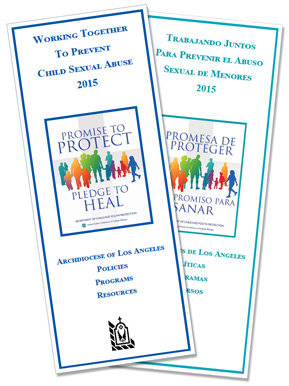 There is a Safeguard the Children (STC) Committee in each parish which helps to implement the objectives of the USCCB “Charter for the Protection of Children and Young People.” The Archdiocese of Los Angeles has produced an informative brochure entitled "Working Together" that provides resources on how to prevent abuse and provides information on reporting child abuse. You can find it along with more information about the policies and activities of the Archdiocese of Los Angeles in “Protecting Our Children" at www.lacatholics.org/departments-ministries/protecting-children/ .
You can also read the monthly bulletin put out by the Archdiocese of Los Angeles at: www.lacatholics.org/did-you-know/
Requirements for Parish Clergy, Staff, and Volunteers at St. Monica
- All volunteers and clergy, along with our staff, regardless of whether they work with or around children in any way, are required to attend a VIRTUS session, “Protecting God’s Children” adult awareness training session.
- Any volunteer who supervises or is perceived to supervise children in any way is required to submit to a background check in the form of fingerprinting by the Archdiocese of Los Angeles. You can sign up for free at LiveScan fingerprinting
- Faith Formation volunteers, students and their parents take part annually in the ”Empowering God's Children” or other approved safe environment education program.
- All parish staff are required to submit to a background check in the form of fingerprinting by the Los Angeles Archdiocese
For a schedule of VIRTUS sessions and fingerprinting at St. Monica, please check latest announcements or the calendar. You can also call the Parish Office at (310) 566-1500 for dates as well.
Upcoming opportunities for VIRTUS and Fingerprinting at St. Monica
Check back for opportunities!
If there are any questions please contact Delis Alejandro, Pastoral Associate at .
Child Abuse Prevention Month
-
Child Abuse Prevention Month: April 2026
In honor of National Child Abuse Prevention Month, April 2026, the Archdiocese of Los Angeles invites you to join us in transforming awareness into action.
The Office of Safeguard the Children is dedicated to “protecting all of God’s children” by fully implementing Article 12 of the Charter for the Protection of Children and Young People adopted by the United States Conference of Catholic Bishops in 2002. The office provides ongoing support, education, training and resources to help prevent child sexual abuse and to address children’s safety in our parishes, schools, homes and communities.
To this end, St. Monica Safeguard the Children (STC) Committee continues to assess and implement the objectives of the charter and to protect vulnerable populations in our midst. Our community regularly hosts VIRTUS training and fingerprinting opportunities to ensure that our volunteers, clergy, and staff have been trained on what a safe environment should look like. It is important that everyone is aware of what abuse can look like, and that we report suspected child or elder abuse. We are all responsible for the care and safety of children and vulnerable adults.
The Archdiocese of Los Angeles also continues helping survivors of sexual abuse and their families during National Child Abuse Prevention Month, and on behalf of Archbishop José H. Gomez, we affirm our continued commitment to report allegations of sexual misconduct to law enforcement, support victim-survivors in their healing journey, and protect children and the vulnerable.
As a community, we hold victims and survivors in our hearts and pray for healing throughout our nation. We will light our candle and in a special way pray for protection and healing from abuse. May we all find comfort in the love and support of our community, gathered together to protect the most vulnerable.
April Child Abuse Prevention Month Petitions
Together this month, let us pray that the vulnerable are protected from abuse, and that survivors of abuse may be accompanied on their paths to healing.

• That God may grant those affected by abuse in any way the courage to tell their
story and seek healing and that they may encounter the presence of Christ: we
pray to the Lord…
• That our leaders in government, that they may be effective in achieving peace and defending the rights of all, especially children and the most vulnerable: we pray to the Lord…
• For children and the vulnerable suffering any form of abuse or neglect, may
they be delivered into the compassion of the Lord: we pray to the Lord…
• For all those who take an active role in preventing child abuse and supporting
victim-survivors – we pray that they have the wisdom and strength to guide
our children through difficult times and set an example for future generations:
we pray to the Lord…
• For an end to all child abuse and neglect, that all of us may be an instrument
of peace, a beacon of light, and a source of healing: we pray to the Lord…. Did You Know?
-
-
Safeguard the Children: Did You know Created on Wednesday, 02 September 2026Read more...
As your children head back to school, parents should begin laying the groundwork (if they haven’t already) for open communication about the school’s safety guidelines and policies. Talk to children about safe adults and keep lines of communication open about who they s...
-
Safeguard the Children: Did You know Created on Tuesday, 25 August 2026Read more...
Back-to-school season is an ideal time to refresh internet safety rules with the children and teenagers in your care. For example, it is helpful to establish clear guidelines like what types of sites they can visit, apps they can download, and when they can have access...
-
Safeguard the Children: Did You know Created on Wednesday, 19 August 2026Read more...
When it comes to schools and programs that serve children, it is critical to have a culture of safety that protects children from sexual abuse. Examine your child’s school or programs for evidence of this culture — look for values that emphasize child safety and decisi...
-
Safeguard the Children: Did You know Created on Monday, 10 August 2026Read more...
In contrast to last week’s article about age-appropriate curiosity, signs that a child is being sexually abused will typically be displayed in more concerning ways. Problematic sexual behaviors include an explicit imitation of intercourse or sexual acts, touching anima...
-
Safeguard the Children: Did You know Created on Tuesday, 04 August 2026Read more...
It is important to distinguish normal, age-appropriate curiosity from concerning sexual behaviors that may be inappropriate or potentially abusive. In general, developmentally appropriate behaviors will be playful, curious, and will be enacted among similar age groups....
-
Safeguard the Children: Did You know Created on Wednesday, 29 July 2026Read more...
Children can suffer from short- and long-term consequences of growing up in a home with domestic violence. The State of California has laws in place to protect children against physical, verbal, and emotional violence done in any home. Any safe adult with a reasonable ...
-
Safeguard the Children: Did You know Created on Wednesday, 22 July 2026Read more...
Summer means more children are using paths and roads for biking, walking, and rolling. That is why the state of California started the “Protect Our Pedestrians. Protect Our Cyclists” education campaign. The campaign calls on drivers to slow down, look out for people of...
-
Safeguard the Children: Did You know Created on Wednesday, 15 July 2026Read more...
Generative Artificial Intelligence is technology that allows a user to create new or alter existing images, videos, or text, based on user prompts or requests. It can be misused to create AI-generated child sexual abuse material, including sexually explicit or exploita...
-
Safeguard the Children: Did You know Created on Tuesday, 07 July 2026Read more...
While parents are often hypervigilant around pools and lakes, drowning can happen at home in an instant, especially with very young children. This summer, watch children around water at home, including buckets, containers, and kiddie pools. Children and babies can drow...
-
Safeguard the Children: Did You know Created on Tuesday, 30 June 2026Read more...
Child safety experts consider grooming a core component of sexual abuse. Grooming is a manipulative process in which a person who intends harm gains access to a child, often through behaviors that seem innocent, and builds up a relationship that will ultimately allow t...
-
Safeguard the Children: Did You know Created on Wednesday, 24 June 2026Read more...
If a minor has had nude or explicit images or videos published on the internet, there is assistance to remove those images online. Take It Down is a free service provided by the National Center for Missing and Exploited Children (NCMEC) that helps to stop the sharing o...
-
Safeguard the Children: Did You know Created on Wednesday, 17 June 2026Read more...
Parents and guardians have a responsibility to be the first line of defense for their children and that starts with boundaries. Set rules around internet use in your home and block access to sites where they can be contacted by others, except for trusted friends and fa...
-
Safeguard the Children: Did You know Created on Monday, 08 June 2026Read more...
If your children are exposed to exploitive and abusive materials online, or if you discover such materials online, please report these exposures to help protect other children and families. You can report an incident to the National Center for Missing & Exploited Child...
-
Safeguard the Children: Did You know Created on Monday, 01 June 2026Read more...
Safe adults who consistently follow the rules and observe healthy boundaries that keep children safe are key to building trust with the children in their care. When you demonstrate healthy boundaries, children are more likely to identify adults who do not follow bounda...
-
Safeguard the Children: Did You know Created on Tuesday, 26 May 2026Read more...
A child’s need to establish a boundary must always be the priority, even over an adult’s desire for affection or connection. If a child does not want to give a hug or even a high five, it is up to the adult to accept that boundary and respect the child’s comfort level....
-
Safeguard the Children: Did You know Created on Tuesday, 19 May 2026Read more...
The National Center for Missing & Exploited Children debuted a new video series called Into the Cloud™ discussing online safety for children. The video series presents digital safety lessons in a fun and age-appropriate manner including strategies for handling cyberbul...
-
Safeguard the Children: Did You know Created on Monday, 11 May 2026Read more...
Keeping children from harm is essential, but it is just as important to prioritize the protection of vulnerable adults. A vulnerable adult is someone who, due to a physical, mental, emotional, or behavior condition, may not be able to protect themselves from harm or ex...
-
Safeguard the Children: Did You know Created on Wednesday, 06 May 2026Read more...
Small things done well and with love can make a huge difference in the life of a child. A safe adult can model appropriate behavior in his or her daily life by following child safety rules, acting appropriately in front of children, volunteering to help with outreach a...
-
Safeguard the Children: Did You know Created on Wednesday, 29 April 2026Read more...
The Daughters of St. Paul (often referred to as the media nuns) have introduced a YouTube series designed to help parents navigate online safety and media skills for their children. The Digital Age Family Safety course offers short videos that teach parents about media...
-
Safeguard the Children: Did You know Created on Tuesday, 21 April 2026Read more...
During National Child Abuse Prevention Month, the Archdiocese of Los Angeles affirms our continued commitment to report allegations of sexual misconduct to law enforcement, support survivor-victims in their healing journey, and protect children and the vulnerable. The ...
-
Reporting Abuse
-
Reporting Child Abuse and Elder or Vulnerable Adult Abuse
It is important that everyone report suspected child or elder abuse. If you ever come across suspected abuse, we urge you to call the Los Angeles County Child Protection Hotline at (800) 540-4000. The hotline is operated twenty-four hours, around the clock, seven days a week. You don’t need to know that child abuse or neglect is taking place, you are welcome to report your suspicions and consult with a social worker if you are not clear whether what you are witnessing or have learned of is abuse. Depending on your profession, you might even be legally obligated to report suspected child abuse and neglect, a so-called “mandated reporter.” But if you are not a mandated reporter, you can even make your report anonymously.
Priests, deacons, school faculty and administrators and other staff members in our parish and schools have been designated as mandated reporters under California law. When one of these persons receives information leading to a “reasonable suspicion” that a child is being abused or neglected, he or she must make a report to the appropriate child protection or law enforcement agency. For more information on Responding to an Allegation of Suspected Child Abuse: www.lacatholics.org/departments-ministries/protecting-children/ .
If you are being abused, have been abused, or know someone who is being abused and you need assistance making a report, call Victims Assistance Ministry at the Archdiocese of Los Angeles at (800) 355.2545,
You may also seek help directly by contacting one of the Child Protective Services or one of the Law Enforcement Agencies listed below. In an emergency, call 911.
- LA County Child Abuse Hotline
(800) 540-4000 - Investigative Control Unit for All Child Abuse Reports
(213) 486-0530 - Los Angeles County Sheriff’s Department
Special Victims Bureau (24 hours)
(562) 946-8531
To speak to a detective
(562) 946-7960 - District Attorney’s Office
Sexual Crimes Division
(213) 974-9790
Family Violence Division
(213) 974-3785 - For callers residing outside of California who wish to contact Child Protective Services in Los Angeles
(213) 639-4500
- LA County Child Abuse Hotline
Volunteer
-
Volunteer Opportunity
The Safeguard the Children committee welcomes inquiries from parishioners with backgrounds in social services, law enforcement, education, child health or legal issues who are interested in joining the committee. Contact Felipe Sanchez at or (310) 566-1502.

Mass
Mon–Fri, 7:00 am - Church
Mon–Fri, 12:10 pm - Church & Livestream
Sat, 8:00 am - Church & Livestream
Sat, 5:30 pm - Church
Sun, 7:30 am - Church
Sun, 9:30 am - Church & Livestream
Sun, 11:30 am - Church
Sun, 5:30 pm - Church & Livestream
Outdoor seating is available at all weekend Masses.
Confession
Mon–Fri. 5:30–6 pm
Sat, 4:30–5:00 pm
There are no confessions on secular holidays or other observances when the parish is closed.
Holy Days & Holidays
Holy Days: additional Vigil and evening Masses, 6:30 p.m.
Holidays: single Mass, 9:30 am with no confessions
Eucharistic Adoration
First & Third Fridays: 7:30–8:30 a.m. & 7–8 p.m. · Church
Second & Fourth Sundays: Noon–3 p.m. · Chapel
contact us
St. Monica Catholic Community
725 California Avenue
Santa Monica, CA 90403
310-566-1500 Contact Us
Saint Monica
Preparatory
stay connected


